
free monthly email list: www.free-management-tips.co.uk
I’ve been thinking about whether it’s possible to achieve as much as you can while also having the best quality of life you can…
Does one come with the other, do they conflict, or are they just not connected? Surely they ARE connected in some way?
So I would like to suggest, based on Maths, that they are linked and there is an optimum position.
You may have seen this graph, which is well documented by stress researchers:
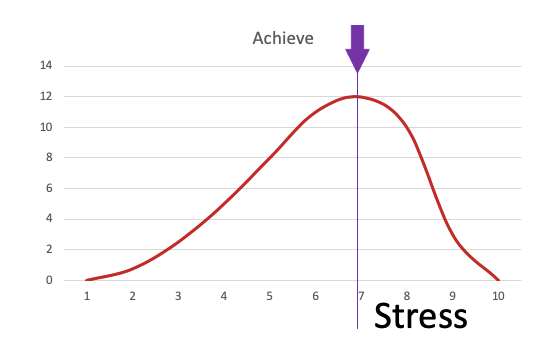
This graph tells us that your point of maximum achievement is at about 7/10 (whatever that means! It’s a personal feeling of how much pressure you are under, from adding up everything you’re doing in your life at the moment) – so below 7 we are under achieving and above 7 we get so stressed we start to perform worse.
In fact the difference between stress and pressure is that stress is when you have too much pressure, ie when you’re above 7.
The graph feels right to me – how about you?
But the question I’m then asking is “Do I WANT to be at 7, right on the limit of achievement, pushing myself relentlessly at 7/10? Maybe I’d like to chill down at 3 or 4, at least some of the time!!
So I think there’s a quality of life graph that has a lower peak than the achievement graph, and in this video I have combined them into a trade-off curve.
And my conclusions of this tradeoff curve are:
- There’s a tradeoff between 3 and 7, where you can achieve more but at a price to the quality of your life.
- Below 3 is definitely lazy and a wasted life
- Above 7 is definitely a bad idea – too stressful and you don’t achieve any more
- Some companies and bosses think that if they push you to 8 or 9 they’ll get more, but they won’t, they’ll get less.
- Some people have a plan to oscillate between 7 and 3: work really hard and then flop on holiday, then repeat for ever. But I think this misses the point of life because it’s all about achieve at work and enjoy at home, and it forgets enjoy at work and achieve at home. Working really hard on a job that you don’t have time to enjoy, and then being too tired to achieve anything outside work, seems to me that you’re missing out on half of the story.
- Have a look at the video and you’ll see that the trade-off graph is quite flat on the top, so 6 is better than 7. You get almost the same achievement and a much better quality of life.
- What this is also saying is that to get that last few % of excellence you have to sacrifice quite lot of quality of life – I think Olympic athletes will confirm this. For a few dedicated people it’s worth paying the price, but I think we get more happiness from dabbling in several things than putting everything into getting slightly better at one thing. After all, will competition lead to happiness? Even no 2 in the world is often unhappy, that dreaded silver medal… So: 6 rather than 7.
- You have a choice between being an achievement maximiser or a quality-of-life maximiser, and I can’t tell you which one you will prefer. You probably already know. If you’re an A then go for 6, if you’re a Q then by the same logic choose 4 rather than 3: you can achieve quite a bit more at 4, for a very small loss of quality of life. So the answer lies between 4 and 6, and you can choose.
- Time Management inflates the balloon: see video for this, but basically everything is better if you’re efficient. If you haven’t already taken my ANIMALS QUIZ (it’s free and very quick) then please do – you can see that half of my “life animals” are achieving less because they aren’t very efficient, so they are playing the trade-off game on the surface of a shrivelled balloon.
- So: where do you want to be, and how will you get there? Do you need to turn the wick up a bit and take on some new projects, or do you need to start saying no and chilling out a bit?
If you haven’t watched the video, have a look, and it will explain the above notes.
And if you like this kind of thing and want to know more:
- please do check out my Stress/Anxiety Course on Udemy.com
- get my free tips of the month here: www.free-management-tips.co.uk


Even though, mathematically, this is prolly bullshit, but still helps intuitively. Graph is only impressing us.
No the graph isn’t to impress, it’s for clarity of explanation. And the hump I start with is a known, researched fact. Sorry you didn’t like my extrapolation from there though. Do you have something better?
vary good information