Some projects are unique one-offs: that’s the classic project.
Some projects are more of a process really: although they have a start and finish, and are quite complicated, they are just the same as the last time we did the job. Everything from updating the servers to building a motorway bridge is quite similar each time. Of course they require all sorts of skill, but the point is they are the same skills doing the same thing each time. Most organisations do things that they have done before – in fact, that’s why the customers hire them!
And many projects are half and half– they are variants on a theme, similar to previous ones but with some new aspects.
So there’s a sliding scale from projectto process, and the process you use should reflect this, as follows:
1 – All projects exactly the same
Use the same Gantt chart every time – once you’ve perfected it over the first few times. Post-it notes (Network diagram) not needed after the first time. Just change the dates on the Gantt chart. Still worth having the Gantt so that everybody knows who is doing what and when, and so you can show it to the customer, and monitor progress by colouring in, and not forget anything, and predict workload requirements ahead of time.
2 – All projects very nearly the same– e.g. install central heating
Use existing Gantt and just change the lengths of the tasks – and the dates obviously.
3 – All projects made up of the same parts – e.g. website
Use a Master Gantt (based on the worst case, the most complicated project ever) as a template. Delete the parts not required. But remember that this might take as much work as doing a new one from scratch, which isn’t difficult, and it is quite prone to mistakes because deleting tasks can affect other things.
4 – Projects vary a lot but do contain similar tasks– e.g. renovating houses.
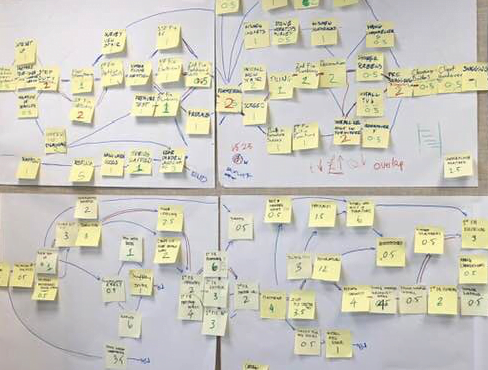
Keep a Master Network Diagram – a postit note chart on your wall. Maybe use laminated squares rather than post-its. So you can move them around easily for new projects, checking you’ve got the dependencies right. But you don’t have to rewrite the tasks each time. With laminated squares you could use a whiteboard pen to write on the new times (task durations in weeks) for each project. So you produce similar but different Gantt charts each time.
5 – Projects completely different every time.
It has to be post-it notes from scratch each time you begin a new project, which leads to a completely new Gantt chart for every project. Still very quick and easy – 2 hours max. And this method allows you to be creative, come up with new and different ideas where possible, and to keep improving the way you do things. If in doubt use this method until you realise that you’ve done the same project several times – then consider the above options.
Onwards and upwards!