A manager or leader should be spending as much time as they can on things that are Important but not Urgent – this is often known as Box 3, also known as quadrant 2, depending on how you draw your diagram of important / urgent. I call it box 3.
PIC
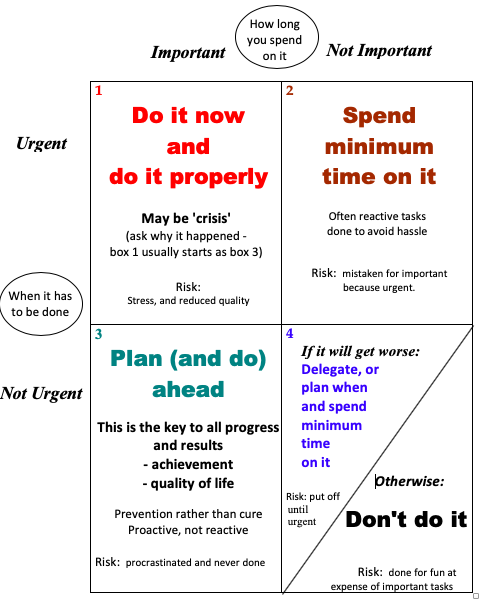
All other time is just reacting, when you’re not in control.
Reacting keeps things going but it doesn’t push them forward. Reacting is a waste of you. When you are reacting you are being predictable, because any decent boss would do the same in your situation.
Your job is not to react, it’s to be creative, to come up with a vision, ideas of how to improve performance, and then make it happen.
Many managers don’t realise this, and they think it is their job to react and fix problems that come up. If there is nothing to react to they LOOK for things to react to, and things to interfere with. This is the road to micro-management and seagull Management (seagulls monitor but don’t support, they come flapping in making lots of noise, poo all over everyone, and go flapping off again). It’s easy to find fault and criticise, that’s not the same as coming up with a better vision and inspiring people to move towards it..

“As much time as possible” in box 3 might only be 10% a day, and is unlikely to ever be more than 40%, But whatever figure you are on, try to make it bigger!
WHAT IS IN BOX 3?
I sometimes ask groups of managers “What would you do if you had more time? What would you like to do, what SHOULD you be doing, what would make a difference to the company?” and the things they tell me are all in box 3.
Here’s a list, which I hope will give you ideas for things you could maybe spend a little bit more time on, just a few minutes each day or occasionally, so that you can be pushing things forwards rather than just reacting.
Thinking
Creativity and ideas
Planning
Investigating e.g. new tech trends
Speaking with the team
Speaking with individuals in order to learn from them and to inspire them, and to show that you value them
Speaking with customers in order to understand them, learn about their future needs, learn about your competitors and your USP, and in the shorter term to see if you can help them by selling them products or services
Analysing performance
Trying to understand the system
Reviewing and processes, including continuous improvement, and automation
Thinking about systems
Measuring, and finding ways to measure
Improving quality
Quality audits – are we following the process we agreed?
Staff development
Self development
Reading
Learning
Having fun
Personal fitness