How can a company suddenly find that it’s a million pounds in the red? Or ten million??
It’ll almost certainly be because of a project.
Everything is a project or a process. And processes are easy to keep track of, because they tend to be the same month on month, or at least they only evolve slowly. The cost of the IT department doesn’t jump up and down from month to month – …but a project might! And you won’t get a sudden shock because someone has recruited an extra 50 planners without you knowing – but a project might well have an expensive month that takes you by surprise.
Let’s look at the finance of projects: there are two ways they can really come and bite you:
- Behind schedule and you don’t know:
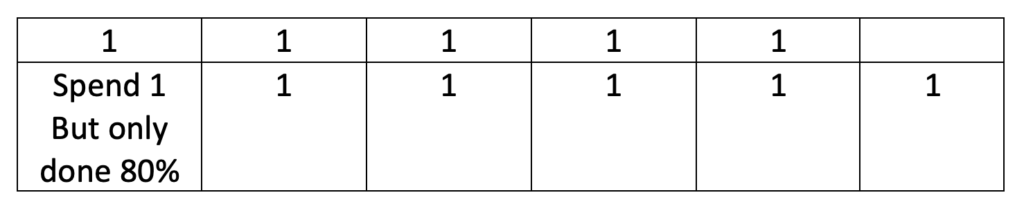
Imagine you are doing a five year project, and it’s supposed to cost you £1million per year. 5 million in total.
And then imagine each year you do indeed spend a million, but you only get 80% of the planned work done. It can be hard to know whether all of the work has been done, when long tasks are half finished, and some are ahead and some are behind, and lots of people from different departments are all doing stuff.
So each year you think you’re OK – you’ve spent the planned million on a whole mixture of things, and a load of progress has been made, …until after 5 years you’ve spent the full 5 million, which sounds OK.
But then you realise that the project hasn’t finished! Oh no! It needs one more year and it’s going to cost another million to get it finished! What can you do? You have to finish it, so you have to spend that extra million. The company is a million worse off. “Which idiot made that million pound mistake?” “How can we suddenly have lost a million pounds??”
2. Unexpected non-linear spend:
Even more tricky than the above, just as common and harder to spot, is the following:

Imagine your project is going to cost £5m over 5 years, but the spend is only going to be half a million for the first and the second year, then one million/year for years 3 and 4, and then two million in the final year. So it starts slowly and ramps up. But what if the accountants didn’t know this, and assumed it was just a linear spend rate of a million a year? Even if the project progresses to plan (unlike the example above) you can still get in massive trouble!
Imagine it’s going to plan in terms of progress, but overspending. What if, in the first year, instead of half a million, a whole million gets spent. The accountants might think “We’ve had one year out of five and we’ve spent one million out of five, so everything is fine”. The same in year two, and we are now a million overspent without anyone noticing. The project is on schedule, all sorts of complicated and clever things are happening, and with difficulty we are adding up all the costs, with their various hourly rates and invoicing/payment time delays, and it’s come to 2 million so far, which seems OK.
How is it possible that the spend of a project is not closely monitored? Well, it can be hard to work out exactly who has worked on a project and which resources have been used, because they cut across departments. There is an assumption that as long as all departments are controlled and stay within costs then everything is OK. But a project that cuts across lots of areas can quietly overspend without being noticed…
So at the end of year 4 we’ve spent 4 million. And then, ‘suddenly’, in the fifth year we spend TWO million, and we end up on 6 instead of 5. Oh no! The company is a million worse off than expected. “Which idiot made that million pound mistake?” “How can we suddenly have lost a million pounds??”
*
The conclusion of this is that in order to control the cost of projects you have to know the progress rate and the planned spend per year (ideally per month), otherwise you can get a sudden shock at the end, and it can be a BIG shock. Luckily both of these, the progress and the spend rate, can be calculated easily from a Gantt chart, but if you don’t have a Gantt chart for your project then it’s virtually impossible to do it.
Have you got a Gantt chart for all of your projects? Can you see the progress so far, by looking at how much is coloured in? And does the Gantt chart include the planned costs of the various tasks so you can see what they are expected to cost each month? If not, …look out!