This looks like any other Project Management handbook doesn’t it? But it’s not….
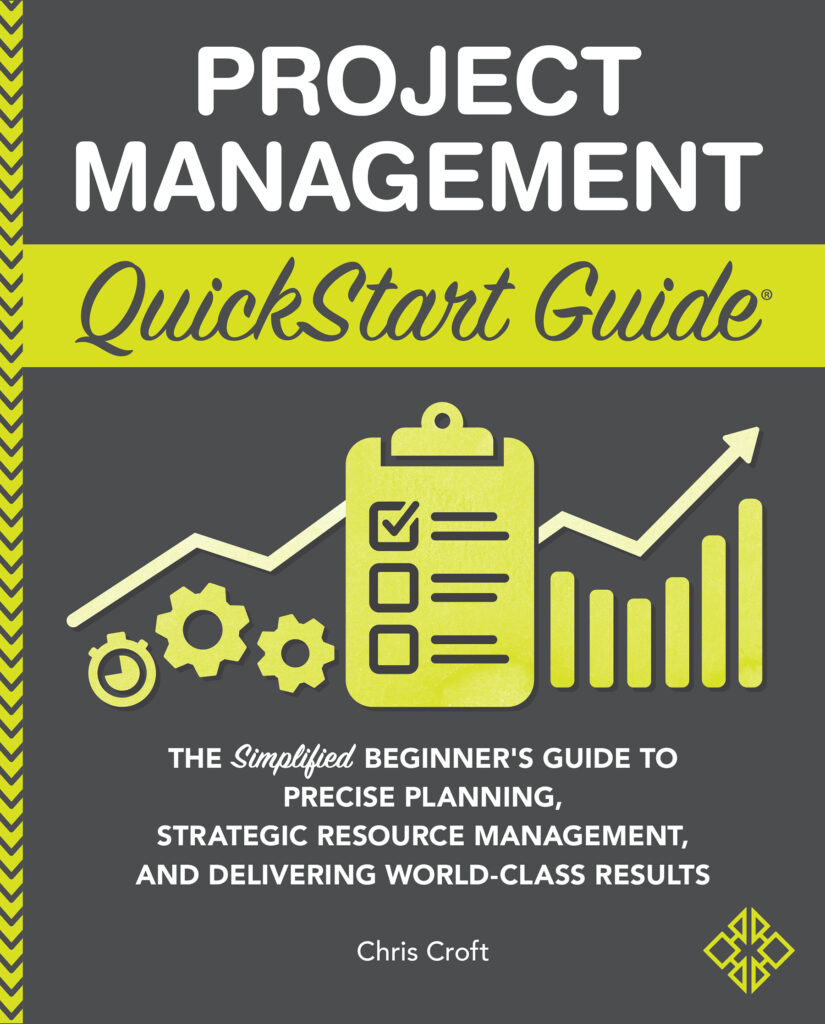
I’ve wanted to set the record straight on a few things for years now, and have finally got my chance. Here are TEN things that you’ll find in my book and nowhere else
1 – No maths! In real life you don’t need to do all that Earned Value stuff, or any of the other maths that people put in their books in order to look clever. Yes, you need to add up all the tasks to get the total cost, but there are not fancy formulas in this book.
2 – Most books show you a Gantt chart and tell you why they are great for timelines and communicating your plan. Then they show you Network Diagrams (aka PERT aka Critical Paths aka Post-it notes) and tell who how these are great for planning the running order and finding the longest path = how long your project will take. And then they leave you wondering which one to use. THIS book explains that you need both, that you should do the post-its first, and how the two methods link up.
3 – A section on PEOPLE. Most projects go wrong because of people, and although that’s really a whole other subject (leadership, motivation, teams, delegation, etc) I’ve put a chunky chapter in on that because I think it’s important. People and leadership from the project management point of view. Most PM books that I have read either ignore the people side, or they are ALL about the people becuase they don’t really understand the hard skills side. You rarely get both.
4 – TWO kick off meetings. I’ve not seen this clearly explained anywhere else, but when you think about it it’s obvious that you need one meeting to decide what the project is, then you go away and plan it, then you need a second meeting to agree your plan: the quality cost and time, with everyeone. It’s not possible to do it all in one meeting.
5 – Contingency: every book trots out the old 1-4-1 method which we’re all taught on our first PM course. But actually if you stopped to think about it, that method isn’t very good. Trust me – it’s explained in the book. I’ve got a much better method for calculating how much contingency to add, where you go half way between the average and the worst case. It’s quicker and easier to do, and gives a more accurrate answer. What’s not to like? And it’s unique to me and to this book.
6 – Activity on Arrow (aka PERT) vs. Activity on Node (aka CPM). This is a bit nerdy, but worth having in a book, because EVERY project management book that I have ever seen only teaches one of the choices – PERT, or CPM. Don’t worry about what they are, but the point is that when you see the other one you won’t know what it is, and also they both have pros and cons so whichever one you choose you need to know about its limitations. In MY book I show you both and explain the pros and cons, and why I prefer CPM. It’s the only book in the world that has both on the same page!

7 – A brand new definitition of Schedule Performance Index! Yes, I hereby claim that the definition of SPI in EVERY PM book in the world is wrong! They all use “value of work done / value of work planned” (go on, google it!) but I suggest using “how long it’s actually taken / how long it should have taken”. When you’re estimating how much longer the whole project will take to complete, my method works better. It’s all explained in the book, and it’s 100% unique to me. And I’m right!
8 – Finance made simple: earned value analysis (or EVA) is horrible, but I have reduced it down to six pictures, which make it really easy to see what’s happening, not just for learning about it bit for actually DOING it in your real projects. Again, we have a practical person who has really thought about this, rather than the academic theorists who spool out the same old horrible (but clever-looking) maths without questioning it. You’ll love my way of doing it.
9 – Forecasting made simple: I’ve not seen a simple explanation of forecasting anywhere else. The idea that if you’re behind schedule, optimists will say “Back onto plan for the second half” while pessimists will say “Same amount of lateness on the second half as well” just makes it easy to understand. And the same for the money – back onto plan, or continuing to over-spend by the same ratio in the second half. You’ll finally understand forecasting when you read this part of my book.
10 – Finally, it’s a modern book because it has lots of links to videos. As you probably know I have loads of those, I like making them, and people seem to find them easy to watch and to understand. And PM is a very visual subject, not always easy to explain in words, so a book with links to videos might be the best of both worlds. I think the videos are a big plus that you get included with this book.
So there we are – it’s taken years to prepare for the writing of this book, years of teaching project management, finding out which parts people find difficult and need to be made simpler or explained differently, years refining the best ways to explain things – and when you have to teach something live to 20 people for a whole day you realise which parts you don’t fully understand yourself, …until finally you really DO understand the subject. I’ve run my course about 2000 times and constantly tweaked it until I know it’s as good as it can be. Having finally perfected my training course I was then able to write this book.
I hope you love it!
Chris
Buy it on amazon here: https://www.amazon.co.uk/dp/1636100589/ref=tmm_pap_swatch_0?_encoding=UTF8&qid=1653900043&sr=8-1